Agama connects stream signaling, delivery metrics and playback data from individual sessions. Teams can check whether an ad played and narrow the investigation to signaling, ad decisioning or playback before more breaks are affected.
Summary
Every live ad break depends on a chain of systems. An SCTE-35 cue marks the opportunity at the headend, the packager carries it into HLS or DASH, and the player requests and plays the ad. A failure anywhere in that chain can cost an ad opportunity that cannot be recovered later. Operations has stream logs, Commercial has impression reports, and Product has device data. Each sees only part of the break, so a failure can go unnoticed until the next day’s reports or a viewer complaint.
How an ad reaches the viewer
Each ad break begins with a signal, typically an SCTE-35 marker at the headend that indicates when an ad break should occur and how long it should last.
As the stream moves through the delivery chain, the packager translates this signalling into HLS playlists or DASH manifests, which are then delivered to viewers through the CDN. In client-side ad insertion (CSAI), the player identifies the ad break, requests an ad from the ad decision server and plays the selected ad before returning to the main content.
Missing markers can prevent insertion; incorrect timing or duration can end a break early or overlap content. Even with correct signalling, ad request timeouts or device playback failures can prevent delivery. Both signaling and playback therefore need monitoring.
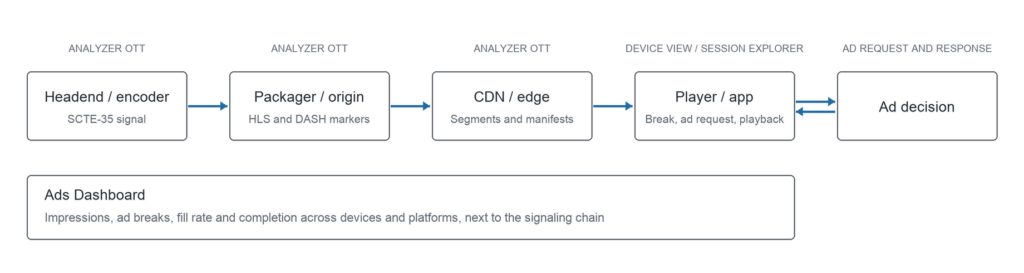
Figure: Probes inspect monitored outputs; instrumented apps report ad events. The ad decision server is observed through its effects, not monitored directly
Getting started with ad observability
Start with one channel and one app
Decide where to monitor, which events to track and what evidence to keep. Compare stream signals with what the player reports during live ad breaks before expanding to more channels or devices.
Monitor the outputs you can access
Configure SCTE-35 analysis, timing expectations and alarms at the stages you want to observe. Enable splice thumbnails and recordings where you need visual evidence.
No ad-server API integration required
The app reports ad breaks, playback events and errors through Agama Client Device Monitoring. Campaign, creative and ad-server metadata support more detailed analysis when available.
