The Agama Analyzer supports two ways to monitor SRT links. It can act as an endpoint in a monitoring session or passively capture traffic from a mirror port. The passive tap captures both directions of the actual session. It uses the session passphrase to decrypt the payload and reconstruct the stream played by the receiver. It measures the time left for packet recovery, where loss occurs, and the health of the return path. The Analyzer then runs its full analysis on the reconstructed stream, using the same views and platform as the rest of the video chain.
Summary
SRT carries live video between pipeline components when managed multicast is not available. It encrypts the payload and repairs packet loss within a set latency window. These features make monitoring harder. Recovery can hide packet loss until the window runs out and the picture breaks. Probes cannot inspect the encrypted video. Each endpoint sees only its side of the link. A separate monitoring receiver sees a different session.
Where SRT fits
Within a facility, video often travels over a managed multicast network. Links between facilities, cloud services and remote productions face less predictable conditions. Packet loss and jitter can disrupt live video on these paths.
SRT handles these conditions across three common uses:
- Contribution – an encoder at an event sends video to a facility or cloud service.
- Delivery between components – SRT connects gateways, transcoders, sites and cloud services.
- Distribution – a listener serves partners or affiliates, with a separate session for each receiver.
The operator is responsible for the service but may control only one endpoint. The network between the endpoints may belong to someone else.
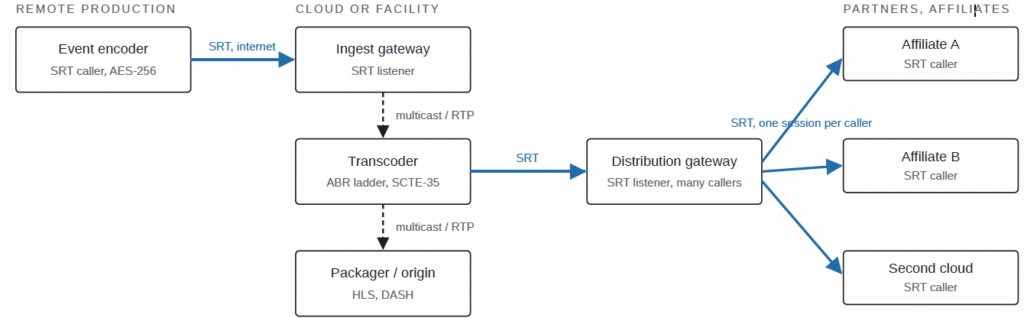
A live video pipeline. In this example, SRT connects the remote production, facility and distributionpartners. Internal links use managed multicast.
Examples
Contribution from an event
The venue connection deteriorates during the evening. Retransmissions rise andheadroom falls, while the output remains clean.
Reviewing latency before replacing a leased circuit
An operator tests SRT as a replacement for a leased circuit. The initial configuration uses200 ms of latency.
Investigating one affiliate’s reception problems
One of twelve affiliates reports picture artefacts. The sender’s aggregate statistics donot reveal which session has a problem.
